Carbon accounting is shifting from a technical back-office exercise to a strategic market requirement—because products compete on attributes, and carbon intensity is fast becoming a decisive one. Yet today, inconsistent methodologies and reporting still limit comparability, trust and the ability to incorporate carbon into transactions.
Watch our video to understand why 2026 is a turning point for carbon accounting—and why harmonization of product-level emissions quantification and reporting could unlock markets - allowing companies to compete on carbon and avert future trade friction.

Carbon Accounting Methodologies Underpin Carbon Markets
How emissions are quantified, accounted, and reported is the connective and defining tissue of carbon markets. Understanding and anticipating implications of carbon accounting methodologies has never been more critical.
Advancing Carbon Related Regulations Are Set To Impact Market Access, Commodity Prices And Trade
Key regulatory measures, such as CBAM, as well as industry led efforts to revisit key standards, has material implications for reporting, emissions performance, trade, and market access. These measures are the building blocks of carbon markets, carbon competitiveness.
Anticipating And Understanding Potential Changes Are Critical To Competitiveness
Staying ahead of evolving standards is essential. With key market changes such as CBAM, and review of leading carbon accounting standards underway in 2026, organizations need monitor, analyse, and adapt at speed minimize risk and maximize value.
Dialogue Gaps: Where is the carbon accounting dialogue converging vs. stalling—and what are the remaining sticking points that directly affect product claims, procurement eligibility, and deal execution?
Evolving Standards: How might existing standards (e.g., the GHG Protocol) evolve—and what would those changes mean for corporate reporting burden, what could this mean for procurement cost, and the viability/liquidity of carbon markets?
CBAM Impacts: What are the practical business impacts of regulations like CBAM on returns, market access, supply-chain redesign, pricing strategy, and competitiveness—and what second-order effects could emerge for trade and geopolitics?
Methane Outlook: How could EU methane regulation evolve—and what would that mean for contractual requirements (MRV), import eligibility, price premia/discounts, what does performance look like and the market opportunity for low-carbon gas?
Trust Framework: What specific mechanisms (data rules, assurance models, product-category guidance, digital infrastructure) are needed to make carbon reporting comparable and trusted enough to support procurement decisions, financing, and carbon-linked transactions at scale?
Calculate, compare and integrate compliance costs with our new tool.
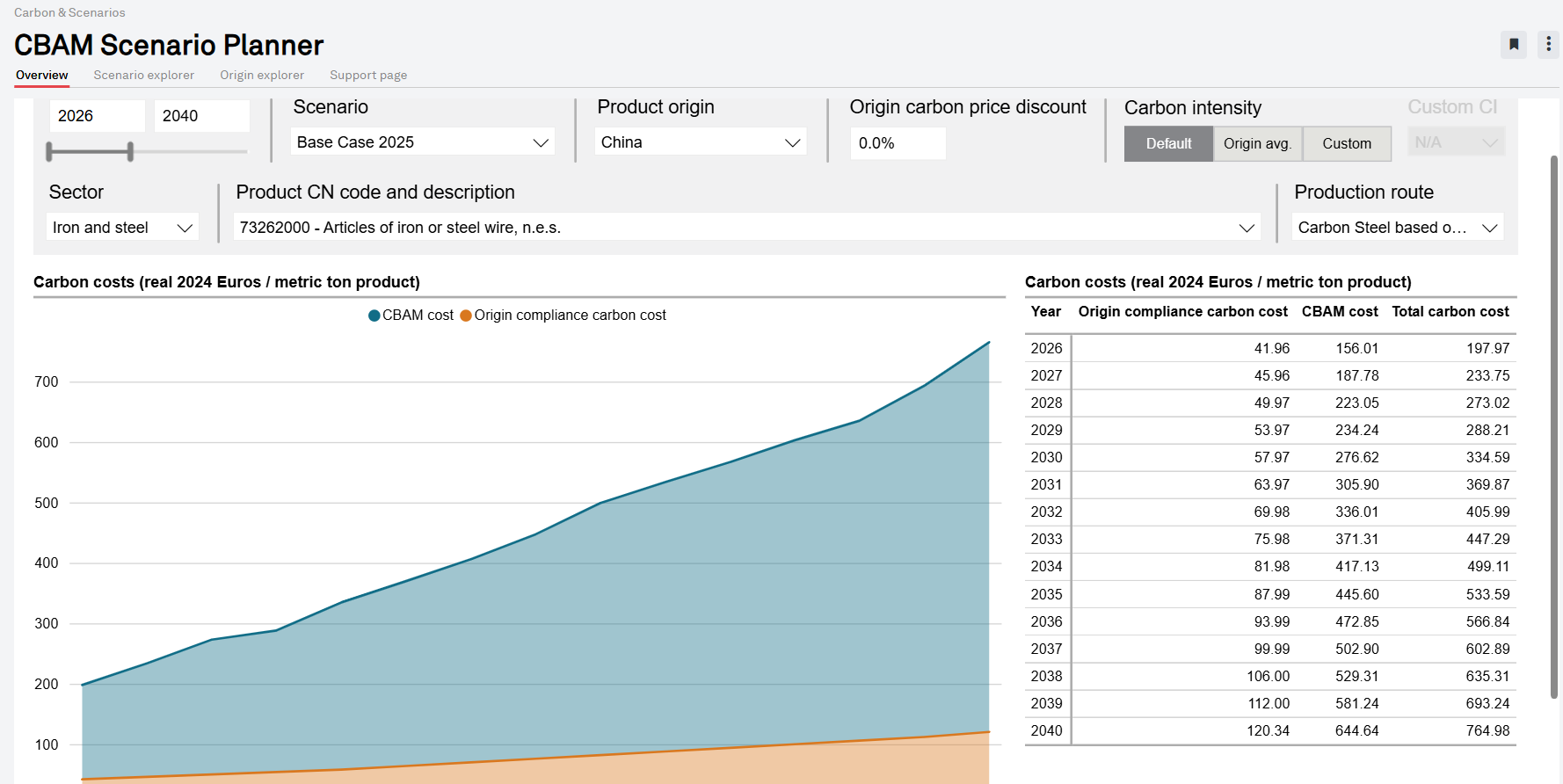
Analyze compliance cost exposure for CBAM products from different countries of origin.
Estimate future compliance costs through 2035 (and extend forecasts to 2060).
Stress-test results across five S& Global Energy scenarios, including Net-Zero 2050 pathways.
Incorporate your own emissions estimates bespoke analyses.
Deliver detailed cost breakdowns and side-by-side comparisons by country, product, and sector.
To discuss how to access our CBAM Scenario Planner, complete the form below.
S&P Global Energy Horizons fuses the essentials for sustainable growth—trusted energy data, advanced sustainability analytics and technology industry insight—to deliver the clarity needed to reach your transition and sustainability goals.
Clean Energy Intelligence: Map the build and buy side of clean energy with coverage spanning 150,000 projects and 250,000 MW of renewable capacity.
451 Research: Track technology companies, financial transactions and energy requirements of 12,960+ data centers globally.
Sustainable1: Data, frameworks and tools spanning 17,000 companies and 99% of global market cap.
The Center of Emissions Excellence: 80+ carbon accounted price assessments and 10 billion tons of GHG emissions mapped in 50+ countries.
Our Energy Expansion and Sustainability experts can help you answer the questions others can't.
Complete the form to connect with a specialist and discuss how we can support your specific workflow needs.